
Removals · Guide
Student moving checklist: what to pack and do
Use this guide before you pack a box. It starts with what the new room already has and how move-in works, then covers packing, transport and the first jobs after you arrive.

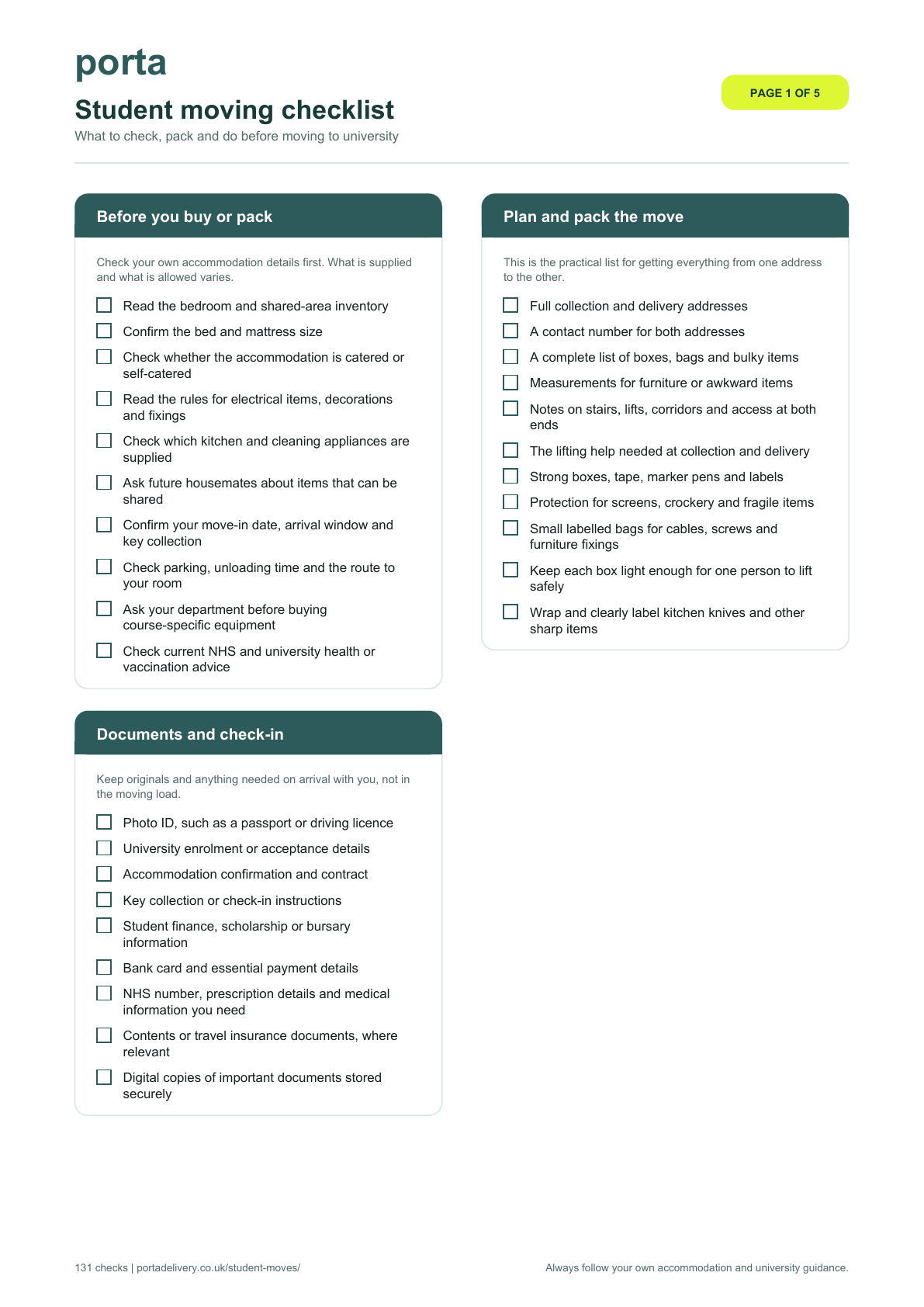 PDF
PDF Free printable checklist
Open or download the full student moving checklist
This is the useful bit to keep beside the boxes. It has 131 checks covering what to confirm, what to pack and what to do on moving day, without printing the rest of the article.
- Before packing
- Documents
- Bedroom
- Kitchen
- Bathroom
- Study and tech
- Moving day
- First week
Five A4 pages. Use your browser's print control to print it. The article is not included.
What should you check before packing for university?
Read the accommodation inventory and arrival instructions before you buy or pack anything. A room in halls may already have a bed, desk, chair and storage, while a private rental could be furnished, partly furnished or empty. Bed sizes, kitchen equipment and rules on electrical items also vary.
Both UCAS and Prospects make the same useful point: check what is supplied before spending money. If you will share a kitchen, wait until you know what your housemates already own before five kettles arrive at the same address.
| Moving into halls | Moving into a private rental | |
|---|---|---|
| Furniture | Usually a defined bedroom inventory; check the exact bed size and storage | May be furnished, part-furnished or empty; use the tenancy inventory |
| Arrival | Key collection or an arrival window may be set by the accommodation provider | Arrange key handover with the landlord or agent |
| Vehicle access | Busy unloading areas may have short stays or staff directions | Check parking restrictions, permits and the route from vehicle to door |
| Shared items | Some kitchen and cleaning equipment may already be provided | Agree appliances, cookware and cleaning equipment with housemates |
| On arrival | Check the room inventory and report damage as instructed | Photograph the condition, check the inventory and take meter readings where relevant |
Four weeks before: decide what to take
Walk through your current room and sort belongings into four groups: taking, leaving at home, donating or selling, and buying later. This is the point to be honest about storage. A small room will not become larger because something looked useful in the shop.
Things you already use
Clothes for the coming season, bedding in the correct size, study equipment, medication and a few things that make the room feel familiar.
Furniture and appliances
A desk, chair, kettle, toaster or vacuum cleaner may already be there. Confirm before adding bulky duplicates to the move.
Shared and easy-to-find items
Kitchen gadgets, cleaning products and extra storage are easier to choose once you have seen the space and spoken to housemates.

Two weeks before: book the move and write the full item list
Once your list is taking shape, count every box, suitcase, appliance, bicycle and piece of furniture. Add both full addresses and check the route from the vehicle to the door at each one. Stairs, lifts, long corridors, security desks and restricted parking all matter on a student move.
Through Porta, you add those details online, choose the lifting help and collection option, and see the fixed price before booking. If you go ahead, Porta connects you with a vetted independent driver. The Student Removals page explains what the service can carry and how the wider booking works.
If you are moving the contents of a furnished room or only a few bulky pieces, the job may also fit Porta's Small Removals service. The small-removals cost guide covers the main things that affect the quote: how much you are taking, the distance, access and the lifting help needed.
One week before: pack in the order you will unpack
Pack the things you use least first, then work towards the everyday items. Books, spare bedding, decorations and out-of-season clothes can go early. Toiletries, medication, chargers and the clothes you still need should stay out until the final day.
- Pack now: books, spare bedding, decorations and anything you will not use before leaving.
- Pack last: everyday clothes, toiletries, chargers and the things still in daily use.
- Keep with you: ID, keys, medication, valuables and the first-night bag.
Keep these things with you, not buried in boxes
Pack one bag for check-in and the first night. It should stay with you, even if everything else is being carried separately. You may need to prove who you are, collect keys or make the bed before there is any chance to unpack the rest.
Student moving-day checklist
Recheck the arrival instructions before leaving, because the correct entrance may not be the main campus gate. Keep the accommodation contact and the person at the collection address easy to reach. When the vehicle arrives, make sure the load matches your list. Before the driver leaves the collection address, check that every item on your list has been loaded.
Before leaving
Keep the essentials bag with you, take a final look through cupboards and confirm someone can receive the move.
At the entrance
Follow the building's parking or unloading instructions and collect the keys before carrying boxes further than necessary.
In the room
Photograph the condition, check the inventory and report anything missing or damaged through the process you were given.
After unloading
Make sure any short-stay bay is cleared promptly, make the bed first and put each labelled box in the right part of the room.

What should you leave at home?
Leave behind anything the property already provides, anything the rules prohibit and anything you are packing only because you might use it once. Extra furniture, duplicate kitchen appliances, a printer, every item of clothing you own and large amounts of food often take space without making the first term easier.
Do not assume one university's prohibited list applies everywhere. Check your own accommodation terms for candles, incense, cooking equipment, plug adaptors, wall fixings and other fire or electrical restrictions. If you are unsure, ask before it goes in a box.
How does a student move work through Porta?
Start with the collection and delivery addresses, then list each box, suitcase, piece of furniture, device, bicycle and appliance. Include the access details and choose the lifting help you need.
Porta shows the fixed price before you book and then connects you with a vetted independent driver for the journey. The move can be across town or between different parts of the UK. If your dates have some flexibility, the part-load removals guide explains how shared vehicle space can work and what timing trade-off to check.