
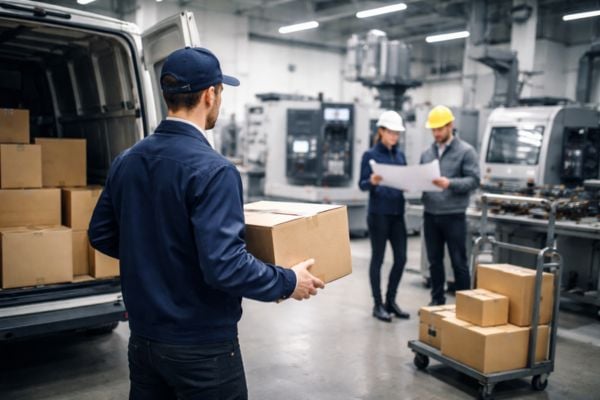

Your CNC machine breaks down at 2pm Friday. Production stops, orders stack up, and every hour of downtime costs £500-2,000 in lost output.
Manufacturing and engineering courier services exist specifically for these emergencies - urgent parts delivery that minimises downtime and keeps production running. Whether it's a critical bearing for a production line, prototype components for testing, or replacement parts for broken machinery, specialist couriers understand that speed genuinely matters in manufacturing.
What This Guide Covers
Specialist manufacturing courier services in the UK, realistic costs for urgent parts delivery, how same-day services minimise production downtime, what items can be couriered, and the difference between manufacturing couriers and standard delivery services that don't understand industrial urgency.
Why Manufacturing Needs Specialist Couriers
Manufacturing and engineering operations can't wait for standard 2-3 day parcel delivery. When machines stop, costs escalate immediately.
The Downtime Cost Problem
Machine downtime in manufacturing typically costs £300-2,000 per hour depending on facility size and production value. A broken bearing on a production line might be a £50 part, but six hours waiting for standard courier delivery costs £1,800-12,000 in lost production.
Same-day courier services that collect within 60-90 minutes and deliver direct reduce downtime from days to hours. The courier premium (£80-200 versus £15 standard delivery) is trivial compared to downtime costs.
Just-in-Time Manufacturing Requirements
JIT manufacturing relies on components arriving exactly when needed - not a day early (tying up cash in inventory) or a day late (stopping production). Specialist manufacturing couriers understand delivery windows matter.
A component needed for 8am Monday production start must arrive Sunday evening or early Monday morning. Standard couriers can't guarantee this precision.
Manufacturing couriers offer timed delivery slots (before 8am, before 10am, specific hour windows) that JIT operations require. The reliability justifies premium pricing.
Heavy and Awkward Components
Engineering parts aren't neat parcels. Sheet metal, machinery components, long steel sections, assembled subassemblies - these require specialist handling that standard couriers can't accommodate.
Manufacturing couriers have tail-lift vans, flatbed vehicles, and equipment for handling awkward loads. They understand that a 2-metre steel shaft or 80kg gearbox needs different handling than cardboard boxes.
For particularly long components like pipework or structural steel, services experienced with 2-metre+ items prevent the rejection problems standard couriers create.
Weekend and Out-of-Hours Breakdowns
Machines don't only break down 9-5 Monday-Friday. Weekend courier services and 24/7 availability matter enormously in manufacturing where production often runs continuously.
A Saturday breakdown in a 24/7 facility can't wait until Monday for parts. Specialist manufacturing couriers operate seven days a week with genuine out-of-hours availability.
What Manufacturing Courier Services Cost
Pricing for manufacturing and engineering deliveries varies based on urgency, distance, size, and timing. Here's realistic cost breakdown.
Emergency Same-Day Parts Delivery
Emergency same-day delivery for breakdown parts - the "machine is stopped right now" scenario - commands premium pricing. Collection within 60-90 minutes, direct delivery to your facility, no depot stops.
Local deliveries (under 30 miles): £60-120 for small parts. Medium distances (30-80 miles): £100-200.
Long distances (80-150+ miles): £180-300+. These costs reflect dedicated vehicle and driver for your delivery only.
Out-of-hours and weekend delivery adds 30-50% premium. A Saturday emergency delivery that would cost £120 weekday runs £160-180 weekend.
Scheduled Same-Day Delivery
When you can plan ahead even slightly - ordering a part at 9am for same-day delivery rather than "need it in 2 hours" - costs reduce. Still same-day service, but less urgency premium.
Small components (bearings, electronic parts, small tools) under 30 miles: £40-80. Medium components (gearboxes, motors, assemblies) 30-80 miles: £70-140.
Large or heavy items (sheet metal, machinery sections) over long distances: £120-250+. Add £30-60 for tail-lift vehicle requirements.
Regular Contract Deliveries
Manufacturers with regular delivery requirements (daily/weekly component runs between facilities, regular supplier collections) negotiate contract rates substantially below ad-hoc pricing. Volume discounts apply.
Daily runs on set routes: £30-70 per delivery depending on distance and volume. Weekly scheduled collections: £50-120 depending on complexity.
Contract services provide reliability (guaranteed collection times, dedicated account management) at lower per-delivery costs than emergency bookings.
| Service Type | Typical Use Case | Collection Time | Cost Range |
|---|---|---|---|
| Emergency same-day (local) | Machine breakdown, urgent repair | 60-90 mins | £60-£140 |
| Emergency same-day (distance) | Critical parts, 80+ miles | 60-90 mins | £140-£300+ |
| Scheduled same-day | Planned delivery, non-emergency | 2-4 hours | £40-£180 |
| Timed AM delivery | JIT components, before 10am | Previous day | £50-£150 |
| Weekend/out-of-hours | Saturday/Sunday breakdown | 90-120 mins | £80-£250+ |
| Heavy/oversized items | Machinery parts, sheet metal | 2-4 hours | £100-£350+ |
| Contract daily run | Regular inter-facility transfer | Scheduled | £30-£100 |
Price Disclaimer: These costs are reflective of current UK market rates at the time of writing and are provided as general guidance only. Actual prices vary significantly based on exact distance, item size/weight, urgency level, time of day, day of week, and specific courier provider. Manufacturing courier services typically quote based on specific requirements rather than published rate cards. Always obtain quotes for your exact delivery needs.
Get An Instant Quote →Types of Manufacturing Items Couriered
Manufacturing couriers handle diverse components and parts. Understanding what can be moved helps with planning.
Small Components and Parts
Bearings, seals, gaskets, electronic components, sensors, small motors, valves, fittings, fasteners, tools - essentially anything that fits in a van without special equipment. These are the bread-and-butter of manufacturing courier work.
Small parts move quickly and cheaply. A bearing for a production line machine fits in a car or small van, keeps delivery costs minimal (£40-100 same-day locally), and gets the machine running fast.
Medium Machinery Parts
Gearboxes, pumps, electric motors, control panels, pneumatic/hydraulic assemblies, compressor parts - items weighing 20-100kg that need van transport but don't require specialist vehicles. This represents the majority of urgent manufacturing deliveries.
These items require proper securing during transport (straps, padding) but standard courier vans handle them fine. Costs reflect weight and size - expect £60-180 for same-day delivery depending on distance.
Heavy and Oversized Components
Large machinery sections, sheet metal, structural steel, assembled frames, heavy castings - items over 100kg or exceeding standard van dimensions. These need tail-lift vehicles, flatbeds, or specialised transport.
For oversized manufacturing parts, costs increase due to vehicle requirements. Tail-lift vans add £40-80 to delivery costs.
Very heavy items (200kg+) or particularly large assemblies might need multiple handlers, further increasing costs. But downtime from waiting days for standard freight makes specialist courier premium worthwhile.
Prototypes and Samples
Rapid prototype parts for testing, sample components for approval, first-off production parts for quality check - time-sensitive items where manufacturing timelines depend on quick delivery. These often need careful handling due to value or delicacy.
Prototype deliveries frequently require specific delivery windows (must arrive before afternoon test session) and documentation (delivery receipts, signed proof of delivery). Couriers experienced with manufacturing understand these requirements.
Hazardous Materials and Chemicals: Some manufacturing components involve hazardous materials - oils, coolants, certain chemicals, gas cylinders. Not all couriers handle hazmat items. If your parts involve dangerous goods, explicitly confirm courier capability and ensure proper labelling/documentation. Standard courier insurance often excludes hazardous materials.
Tools and Equipment
Specialist tools needed urgently at facilities, calibration equipment, testing gear, maintenance tools - items supporting production rather than being production components themselves. These deliveries keep maintenance and engineering teams working effectively.
Tool deliveries often involve high-value items (precision measuring equipment, specialist cutting tools) requiring adequate insurance. Confirm coverage limits before booking - standard £500-1,000 insurance inadequately protects £5,000 measurement equipment.
How Manufacturing Courier Services Work
The process differs from standard parcel delivery. Understanding how manufacturing couriers operate helps you use services effectively.
Booking and Collection
Most manufacturing couriers offer immediate phone booking with collection within 60-90 minutes. You call, provide collection address, delivery address, item description, and urgency level.
Courier quotes based on these details and confirms collection time. Driver collects direct from your facility - no dropping at depots or collection points.
Door-to-door service is standard in manufacturing - collection from your goods-in, delivery to recipient's goods-in. No messing about with parcel shops or depot collections.
Tracking and Communication
Real-time tracking matters enormously when production depends on delivery. Good manufacturing couriers provide live tracking, estimated arrival times, and proactive communication about delays.
You can see exactly where your bearing or motor is, when it'll arrive, and plan accordingly. This visibility helps production planning - you know whether to keep trying to nurse a failing machine along or shut down and wait for the part.
Proactive delay communication distinguishes good services from poor ones. Traffic problems happen, but being told "delivery delayed 45 minutes" at the point delay occurs beats discovering it when the courier should have arrived.
Direct Delivery and Proof
Manufacturing couriers deliver direct - no depot consolidation, no multi-drop rounds, no overnight warehouse stops. Your part goes from collection point to delivery point by the fastest route.
Proof of delivery with signature and timestamp provides accountability. When a critical part "doesn't arrive" and production is stopped, delivery proof shows exactly when it was handed over and to whom.
Some services photograph deliveries, particularly for high-value items. This documentation prevents disputes about condition or whether items were actually delivered.
Emergency Breakdown Protocol
For genuine emergencies - machine stopped, production halted - communicate urgency clearly when booking. Provide the part number, collection point contact, delivery contact, and emphasise downtime costs.
Good manufacturing couriers prioritise genuine emergencies, sometimes rerouting drivers mid-job. But crying wolf on urgency reduces credibility - save "emergency" classification for actual emergencies.
Manufacturing Couriers vs Standard Delivery Services
Standard parcel couriers and manufacturing specialist services solve different problems. Understanding differences prevents costly mistakes.
Speed and Urgency Understanding
Standard couriers operate next-day or 2-3 day delivery. "Urgent" means next-day rather than 2-day - helpful, but inadequate when machines are stopped.
Manufacturing couriers understand that urgent means "collect now, deliver today, production depends on it." They price and operate accordingly - dedicated vehicles, direct delivery, no depot delays.
Handling Capability
Standard couriers handle parcels - items in boxes under 30kg that fit conveyor belts and can be manually handled by one person. Anything heavier, larger, or awkward gets rejected or requires special arrangements.
Manufacturing couriers expect heavy, awkward items. A 60kg gearbox or 2-metre steel section doesn't faze them - they have equipment and vehicles designed for industrial components.
Cost vs Value Understanding
Standard couriers compete on price. £8 delivery versus £12 delivery matters when you're shipping thousands of low-value parcels.
Manufacturing couriers compete on speed and reliability. The difference between £120 and £180 delivery is irrelevant when downtime costs £1,000/hour.
This mindset difference matters. Manufacturing couriers understand that you're paying for production uptime, not just transport.
Out-of-Hours Availability
Standard couriers operate business hours, Monday-Friday. Weekend delivery exists but limited. Evening/night delivery essentially doesn't exist.
Manufacturing couriers offer 24/7 availability because breakdowns don't respect business hours. A 10pm Saturday breakdown gets same urgent response as 2pm Tuesday breakdown.
When Standard Couriers Work for Manufacturing
Not every manufacturing delivery needs specialist services. Non-urgent component deliveries, consumables, office supplies, documentation - standard next-day couriers handle these fine at lower cost.
Use manufacturing specialists for: emergency breakdowns, JIT deliveries with precise timing, heavy/awkward items, weekend/out-of-hours needs, high-value components requiring enhanced insurance. Use standard couriers for: non-urgent deliveries, lightweight standard parcels, office supplies, where timing flexibility exists.
Minimising Downtime with Strategic Courier Use
Smart manufacturers use courier services strategically to reduce overall downtime risk and costs.
Critical Spares Inventory Strategy
Some components are so critical that stocking spares makes sense despite inventory costs. Motor bearings, seals, common electrical components - items that fail regularly and cause expensive downtime.
For less critical or expensive parts, courier services provide "just-in-time spares inventory." Rather than stocking a £2,000 gearbox that might fail once every 2 years, pay £150 courier costs when it actually fails.
The calculation: £2,000 tied up in inventory that might not be needed for years, versus £150 + 4 hours downtime (£2,000 production loss) when failure occurs. Courier option costs similar but frees capital.
Supplier Relationships and Courier Coordination
Negotiate with suppliers to keep stock of your commonly-needed parts and arrange courier delivery when needed. Supplier holds inventory, you call for emergency delivery when required.
This works particularly well with specialist component suppliers who understand manufacturing urgency. They keep your specification parts in stock, and courier them same-day when you call.
Preventive Maintenance Scheduling
Schedule planned maintenance when courier services are cheapest (weekday, standard hours) rather than waiting for emergency weekend breakdowns. Order parts for Tuesday delivery, perform maintenance Wednesday.
Planned maintenance with scheduled delivery costs £40-80 courier. Emergency weekend delivery of the same part costs £120-200+.
False Economy of Cheap Freight
Some manufacturers try saving money by using cheap freight for urgent parts. A £20 freight service that takes 3 days versus £120 courier delivering same day seems economical.
But three days of production downtime at £500/hour = £12,000 cost. The £100 "saved" on courier costs £12,000 in lost production.
Choosing Manufacturing Courier Services
Not all manufacturing couriers deliver equal service. Choosing reliable providers matters when production depends on delivery.
Experience with Industrial Clients
Couriers with manufacturing sector experience understand urgency, handling requirements, and delivery expectations. They know that "deliver to goods-in" means finding goods-in department, not leaving parcels at reception.
Ask potential couriers: What percentage of your work is manufacturing/engineering? Can you provide references from industrial clients? What's your experience with [your specific industry]?
Couriers who primarily handle consumer parcels but claim they "can do manufacturing too" often disappoint when tested.
Vehicle Fleet and Capabilities
Check courier vehicle availability: small vans for small parts, large vans for bigger items, tail-lift capability for heavy loads, flatbeds for awkward items. A courier with only small vans can't handle your 80kg pump emergency.
Geographic coverage matters too. A courier with vehicles nationwide can handle deliveries anywhere.
One based only in Southeast struggles with urgent deliveries to Manchester or Scotland.
Insurance and Liability
Standard courier insurance (£500-1,000) inadequately covers expensive engineering components. A precision machined assembly worth £8,000 needs proper coverage.
Confirm insurance limits and enhancement options before using couriers for high-value items. Enhanced insurance (1-2% of value) is cheap protection for expensive parts.
Understand liability terms: damage caused by inadequate packaging versus courier mishandling, time limits for reporting damage, claims process and typical resolution times.
Pricing Structure and Transparency
Manufacturing couriers should provide clear quotes based on specific requirements. Vague pricing or hidden surcharges create problems when urgent deliveries already create stress.
Understand what's included: collection from your facility, delivery to recipient facility, insurance level, proof of delivery, tracking access. Clarify extra charges: out-of-hours premium, weekend rates, tail-lift vehicles, waiting time.
Contract Rates for Regular Users: If you use courier services regularly (weekly or more), negotiate contract rates. Volume discounts, priority service, dedicated account management, and preferential pricing during emergencies make contracts worthwhile for frequent users.
Common Manufacturing Courier Problems
Certain issues appear repeatedly with manufacturing deliveries. Understanding them helps avoid the same mistakes.
Rejected Collections Due to Size/Weight
Courier arrives to collect your "small motor" which turns out to be 90kg and won't fit their van. Collection refused, you're back to square one, production still stopped.
Prevention: Provide accurate dimensions and weight when booking. Better to overestimate than underestimate.
If you say "small part" and it's actually a 40kg gearbox, couriers send inappropriate vehicles. Be specific: "60kg electric motor, dimensions 50x40x30cm."
Delivery to Wrong Location at Facility
Part delivered to main reception instead of goods-in or maintenance department. Sits in reception for 2 hours while production remains stopped waiting for the "delayed" part that's actually already on-site.
Provide specific delivery instructions when booking: "Deliver to Goods-In Dept, Building 3, ask for Dave in Maintenance." Include contact phone numbers for delivery location.
Follow up with recipient to watch for delivery rather than assuming it'll find the right department automatically.
Inadequate Packaging Causing Damage
Precision components packed poorly arrive damaged. Courier insurance doesn't cover damage from inadequate packaging.
Pack industrial components properly even for urgent deliveries: padding for delicate items, secure wrapping for oily parts, protection for precision surfaces. Five minutes packaging prevents hours of additional delay sourcing replacement for damaged parts.
Time-Critical Delivery Missed
Part needed for 8am Monday shift start arrives at 9:30am. Production already delayed 90 minutes, defeating the point of paying premium for urgent delivery.
When timing is critical, use couriers offering specific time guarantees (delivery by 8am, delivery within specific hour) rather than vague "morning delivery." Pay for the guaranteed service - it's worth it when production timing matters.
The Communication Gap
Manufacturing emergencies create stress. Sometimes that stress causes communication gaps between facilities, procurement, and couriers leading to delays or errors.
Implement clear protocols for emergency courier bookings: who has authority to book, what information gets provided to couriers, how delivery confirmation gets communicated back to production. Clear processes prevent mistakes when urgency creates pressure.
Final Thoughts: Manufacturing Courier Services as Production Insurance
Manufacturing and engineering courier services aren't just delivery - they're production insurance. The ability to get critical parts delivered urgently prevents downtime from turning catastrophic.
Machine breakdowns happen. Components fail unexpectedly.
JIT deliveries get delayed. When these situations occur, access to reliable courier services that understand manufacturing urgency makes the difference between minor disruption and major production loss.
The costs - £60-300 for emergency delivery - seem high compared to £15 standard courier pricing. But measured against downtime costs (£300-2,000/hour), they're trivial.
A £180 same-day delivery that gets production running 6 hours faster saves £1,800-12,000 in prevented downtime. The courier service doesn't cost money - it saves money.
Smart manufacturers build relationships with reliable courier services before emergencies occur. Having established contacts, agreed rates, and proven service quality means when 2pm Friday breakdown happens, you're making one phone call to a known reliable service rather than frantically Googling "urgent courier" and hoping for the best.
Our Recommendation
For manufacturing and engineering operations, maintaining relationships with specialist courier services provides essential production continuity insurance. Services like Porta Delivery understand industrial urgency and can connect manufacturers with reliable courier networks experienced in handling time-critical parts delivery.
The UK has adequate manufacturing courier capacity at all service levels - from emergency same-day to contract regular deliveries. The challenge is matching your specific needs (urgency, size, distance, budget) with appropriate services, establishing relationships before emergencies create pressure, and understanding that courier costs are production continuity investments rather than transport expenses.