
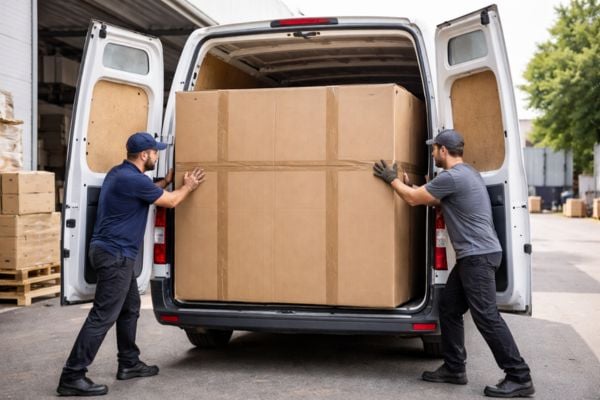

You're standing in your hallway staring at a sofa you've sold on Facebook Marketplace, a wardrobe that needs moving across the country, or a washing machine that's somehow got to reach your new flat 80 miles away. It won't fit in your car, standard couriers have laughed at the dimensions, and you're rapidly discovering that shipping anything genuinely large in the UK is considerably more complicated than you'd imagined.
The frustrating reality is that once parcels exceed certain size and weight thresholds, the affordable and straightforward courier options you'd use for regular packages simply stop working. You're pushed into a middle ground where items are too big for standard networks but not quite substantial enough for freight services, and the pricing suddenly becomes confusing and often surprisingly expensive.
But large parcel delivery doesn't have to be a nightmare of rejected bookings and astronomical quotes. Understanding what actually qualifies as "large," which couriers handle different types of bulky items, and crucially how to package and book properly makes the entire process manageable and often quite affordable.
If you already know what you need to ship and just want a price, head straight to Porta's large item delivery service for an instant quote in 10 seconds. This guide covers everything else, including size limits, costs, packaging, and how to choose the right courier.
What This Guide Covers
We'll walk through everything you need to know about shipping large parcels in the UK – from understanding size classifications and weight limits to finding the right courier for specific items like furniture, appliances, bikes, and sports equipment. You'll learn realistic costs, how to avoid damage, and when professional services genuinely make more sense than DIY alternatives.
What Actually Qualifies as a Large Parcel?
Before diving into solutions, it's worth establishing what "large parcel" actually means, because different couriers use surprisingly different definitions and the classification significantly affects your options and costs.
Standard Parcel Limits
Most standard UK parcel services (Royal Mail, Evri standard, DPD standard) accept parcels up to roughly 60cm x 60cm x 60cm and 10-15kg. Anything exceeding these dimensions or weights gets classified as "large" and requires different services with different pricing structures.
This threshold matters because standard networks use automated sorting systems designed around these limits. Once your parcel exceeds them, it requires manual handling at every stage, which immediately increases cost and complexity. Your £5 standard parcel suddenly becomes a £15-40 large parcel service purely because it's 70cm long instead of 60cm.
Large vs Extra Large Classifications
Within "large parcel" services, there are typically tiers. DHL, for instance, classifies parcels up to 60x60x60cm and 20kg as "large," whilst anything up to 120x70x70cm and 30kg is "extra large." Parcelforce separates standard services (up to 1.5m length) from their Express 48 Large service (up to 2.5m length).
These distinctions aren't just marketing – they represent genuinely different handling processes, vehicles, and routing. An "extra large" parcel might travel on different vehicles, through different depots, and take longer routes than a standard large parcel. Understanding which category your item falls into prevents booking services that will reject your parcel or apply surprise surcharges.
The Volumetric Weight Trap
Large parcels often trigger volumetric weight pricing, where couriers charge based on size rather than actual weight. A lightweight but bulky item – say a large cushion or lampshade – might weigh 3kg but have volumetric weight of 15kg, meaning you're charged for 15kg. This catches people out constantly. Always check if volumetric weight applies and calculate it before booking rather than discovering the real cost afterwards.
When Items Become Freight
Once parcels exceed about 30-40kg or 2.5m in any dimension, you're often better off using pallet or freight services rather than stretching large parcel service limits. Professional large item courier services understand this threshold and can advise whether your item suits parcel networks or requires freight handling.
Freight services seem expensive until you compare them to premium large parcel rates – sometimes a £60 palletised freight delivery makes more sense than a £55 "extra large parcel" service, particularly if your item is fragile or valuable and benefits from pallet protection.
Common Large Items People Need to Ship
Understanding what category your item falls into helps identify the most appropriate courier service and realistic costs. Different items have different challenges beyond just size and weight.
Furniture & Home Items
Sofas, wardrobes, dining tables, shelving units. Challenges: awkward shapes, assembly/disassembly, protection needed.
White Goods & Appliances
Fridges, washing machines, dishwashers, ovens. Challenges: weight, upright transport requirements, installation needs.
Beds & Mattresses
Bed frames, headboards, mattresses of all sizes. Challenges: length, bending restrictions, hygiene protection.
Bikes & Cycling Equipment
Road bikes, mountain bikes, e-bikes, accessories. Challenges: fragile components, wheels, packaging requirements.
Sports Equipment
Golf clubs, gym equipment, kayaks, surfboards. Challenges: length, specialist protection, value.
TVs & Electronics
Large screen TVs, monitors, audio equipment. Challenges: fragility, screen protection, insurance needs.
Musical Instruments
Pianos, keyboards, drum kits, guitar amps. Challenges: weight, tuning sensitivity, specialist handling.
Garden Equipment
Lawnmowers, garden furniture, barbecues, sheds. Challenges: outdoor items, fuel/battery concerns, seasonal demand.
Pool Tables & Games
Pool tables, arcade machines, gaming chairs. Challenges: extreme weight, disassembly, precise handling.
Automotive Parts
Bumpers, bonnets, wheels, exhausts, car seats. Challenges: odd shapes, sharp edges, vehicle-specific timing.
Long Items
Curtain poles, skirting boards, timber, artwork. Challenges: length limits, manual handling, sorting system incompatibility.
Mobility Equipment
Mobility scooters, wheelchairs, walking aids. Challenges: batteries, weight, delicate electronics, user dependence.
Each category has specialist courier services that understand the specific challenges. Sending a piano requires completely different expertise than shipping a bike or a pool table. Generic "large parcel" services work for some items but not all – choosing appropriately matched services prevents damage and failed deliveries.
UK Courier Options for Large Parcels
Right, let's get into which couriers actually handle large parcels well, what they cost, and crucially what limitations they have that aren't always obvious from their websites.
National Parcel Networks: DHL, Evri, DPD
The major national networks all offer large parcel services, typically covering items up to 30kg and specific dimension limits. DHL's extra large service goes up to 120x70x70cm for £8.80+, Evri handles up to 120cm length and 15kg, whilst DPD's large parcel options vary by specific service.
These services work brilliantly for items at the smaller end of "large" – perhaps a medium-sized box of books, a pushchair, or a medium flatpack furniture item. They're affordable, widely available, and offer decent tracking and reliability. However, they have hard limits, and trying to stretch these services beyond their design parameters leads to rejections and surcharges.
The key advantage is cost – at £5-20 for many large parcels, these services undercut specialist alternatives significantly. The disadvantage is they're designed for parcels that can still navigate depot systems with minimal manual handling, so genuinely bulky or awkward items don't work well.
Parcelforce Express 48 Large
Parcelforce's large service accepts parcels up to 2.5m in length and 30kg in weight, with combined length and girth up to 5 metres. This makes it one of the most generous services for genuinely large items that still fit within parcel network parameters.
For items like furniture legs, bed frames, sports equipment, or anything in the "too big for standard but not quite freight" category, Parcelforce Large works well. Pricing is published and relatively consistent – you can get accurate quotes online rather than needing custom quotations.
The service includes collection from your door, two-working-day delivery, and proper tracking. It's not same-day or next-day fast, but for non-urgent large item delivery across the UK, it represents good value for money at predictable costs.
Specialist Large Item Couriers
Services that specialise in furniture, appliances, and awkward items provide capabilities that general parcel networks simply don't have. Two-person delivery teams, proper handling equipment, insurance for high-value items, and drivers experienced with bulky goods make a genuine difference.
For furniture delivery, appliance moving, or items requiring careful handling, paying £60-100 for proper service prevents the £200+ cost of replacing damaged goods when cheaper services go wrong. The premium covers expertise, not just transport.
These services also handle edge cases that standard networks reject – items over 30kg, furniture requiring disassembly, appliances needing installation, or fragile items worth thousands of pounds. If your item falls outside standard parcel parameters, specialist services are often your only realistic option.
Real Experience: Sofa Delivery Gone Wrong
Tom sold a 2-seater sofa on eBay for £150 and used a budget "large parcel" courier service for £35 to save money. The courier arrived in a small van, couldn't fit the sofa through the door properly, damaged the frame trying to force it, and left it poorly secured. It arrived at the buyer's address with torn fabric and a cracked leg. Tom had to refund the buyer, lost the sofa, and paid for return transport. Total cost: £380. A proper furniture courier would've been £65 and handled it professionally. False economy.
Same-Day and Urgent Services
When large item delivery genuinely can't wait, same-day courier services provide dedicated transport for urgent requirements. A driver collects your item and delivers directly without other stops, typically within 3-6 hours depending on distance.
This works for business-critical items, urgent replacement appliances, or situations where the consequence of delay exceeds the transport cost. For most non-urgent large parcels, same-day services are unnecessary expense, but when timing genuinely matters, the option exists.
Get An Instant Quote →What Large Parcel Delivery Actually Costs
Pricing for large parcels varies dramatically based on size, weight, distance, and service level. Let's break down realistic costs for common scenarios based on current UK courier rates.
| Item Type | Typical Specs | Service Type | Cost Range |
|---|---|---|---|
| Medium Flatpack Furniture | 100x60x30cm, 15kg | National large parcel | £12-£25 |
| Washing Machine | 85x60x60cm, 70kg | Appliance specialist | £45-£80 |
| 2-Seater Sofa | 180x90x80cm, 45kg | Furniture courier | £60-£120 |
| Bike (boxed) | 150x80x30cm, 12kg | Specialist bike courier | £25-£50 |
| Large TV (65") | 150x90x20cm, 25kg | TV specialist | £35-£70 |
| Wardrobe (disassembled) | 220x80x20cm, 60kg | Furniture courier | £70-£130 |
| Mobility Scooter | 140x70x100cm, 55kg | Specialist disability courier | £60-£140 |
| Pool Table | 250x150x80cm, 250kg | Specialist + 2 person team | £150-£300 |
| Garden Furniture Set | Multiple boxes, 40kg total | Multi-box large parcel | £40-£85 |
| Lawnmower (ride-on) | 180x90x110cm, 180kg | Garden equipment specialist | £80-£150 |
These costs assume UK mainland delivery over moderate distances (50-150 miles). Very local deliveries (under 20 miles) might be slightly cheaper, whilst long-distance or remote locations add £20-50 to these figures. Weekend delivery typically adds 20-30% premium over weekday costs.
Distance vs Size vs Weight Pricing
For standard parcels, weight dominates pricing. For large parcels, the relationship between distance, size, and weight becomes more complex. A lightweight but bulky item might cost more than a heavy compact item over the same distance because it occupies more vehicle space. Always provide accurate dimensions when quoting – underestimating leads to surcharges, whilst overestimating means you're paying for space you're not using.
Packaging Large Parcels Properly
Getting packaging right for large items is genuinely important – these parcels suffer higher damage rates than standard boxes because of how they're handled and the forces involved during transport.
Box Selection and Strength
Standard single-wall cardboard boxes don't cut it for large, heavy items. You need double-wall or even triple-wall cardboard, properly sized for your item with minimal empty space. Packaging suppliers sell purpose-made boxes for specific items – bike boxes, TV boxes, flatpack furniture boxes – and using the right one makes an enormous difference.
For items without suitable boxes available, consider wooden crates for valuable or fragile goods, or pallet wrapping for furniture that can't be boxed. The packaging investment often costs £15-40 but protects items worth hundreds or thousands of pounds. It's not optional for responsible shipping.
Internal Protection and Cushioning
Large items need substantial internal cushioning – bubble wrap, foam sheets, packing peanuts, or air pillows. Corners and edges particularly need protection as these take the most impact during handling. For appliances and electronics, original packaging provides optimal protection if you still have it.
Items with screens (TVs, monitors) need rigid protection over the screen surface – cardboard or foam board, not just bubble wrap which can allow impact through to the screen. For furniture with glass or mirrors, remove these components if possible and package separately, or provide rigid reinforcement.
Securing Contents: Items that shift inside packaging during transit often arrive damaged. For furniture with drawers or doors, tape them shut. For appliances with moving parts, secure according to manufacturer guidelines. For items in original boxes, check the box itself is sturdy – original packaging that's been stored for years might have deteriorated and needs reinforcement.
Labelling and Documentation
Large parcels need labels on multiple sides, not just one. When handlers move large items, they approach from different angles and need to see the address and handling instructions from various positions. Put your courier label clearly visible on at least two sides, ideally with "THIS WAY UP" or "FRAGILE" markings if appropriate.
For high-value items, consider taking photos of the packaged parcel before handing over to courier. This documents packaging quality if disputes arise later about whether damage occurred due to inadequate packaging or courier mishandling.
Special Requirements for Specific Items
Some large items have particular packaging requirements. Appliances with compressors (fridges, washing machines) must travel upright or at specific angles. Bikes need pedals removed and handlebars turned to reduce width. Mattresses need plastic wrapping for hygiene. TVs must be vertical with screen protection. Research your specific item type – proper packaging often means the difference between safe arrival and expensive damage.
Booking Large Parcel Delivery: What Actually Works
The booking process for large parcels has some specific considerations that differ from standard parcel shipping. Getting these right prevents failed collections and surprise charges.
Accurate Measurements are Critical
Measure your packaged item carefully – length, width, height in centimetres, and weight in kilograms. Use a proper tape measure, not eyeball estimates. Round up rather than down if you're between measurements. Couriers measure parcels at depots, and if your declared dimensions don't match reality, surcharges apply – sometimes £40-80 for significant discrepancies.
For awkward shapes, measure the maximum dimensions in each direction, including any protruding parts. A sofa with legs might have different dimensions than the main body – measure the full extent including legs, not just the central section.
Collection Arrangements
Large parcel collections often require longer time windows than standard parcels. The courier needs a suitable vehicle, and collection routes for large items differ from standard delivery rounds. Book collections at least 24-48 hours in advance, specify clearly if there are access issues, and ensure someone's available for the entire collection window.
If your large item is upstairs, mention this when booking. Some couriers charge extra for stairs, others won't attempt them at all with heavy items due to health and safety regulations. Finding out on collection day that your 60kg appliance can't be collected from a first-floor flat because nobody mentioned the stairs wastes everyone's time.
The "Ground Floor Only" Reality
Most standard courier services have ground floor collection and delivery limits. Single drivers can't safely manoeuvre heavy large items up stairs without help, and insurance doesn't cover injuries from attempting it. If you need multi-floor collection or delivery, book services specifically offering two-person teams or assistance – these cost more but actually work, rather than booking cheaper services that will refuse on the day.
Comparison Sites vs Direct Booking
Parcel comparison sites work well for standard parcels but can be hit-and-miss for genuinely large items. The sites sometimes show prices for services that later reject your dimensions, or quotes that trigger surcharges after booking. For items at the larger end of large parcel services, getting quotes directly from couriers or through specialist brokers often provides more accurate pricing.
Platforms like Porta Delivery connect shippers with independent drivers for bulky and awkward items, matching your job with drivers on similar routes to find services that genuinely fit your requirements rather than showing you lowest prices that won't actually work.
Insurance Considerations
Standard transit insurance typically covers £50-100, which is inadequate for most large items. A sofa worth £800, a washing machine worth £600, or a bike worth £1,200 all need enhanced insurance cover. This costs 1-2% of declared value but provides genuine protection if damage or loss occurs.
Read insurance terms carefully – some policies exclude certain items, have packaging requirements that void cover if not met, or limit claims for "cosmetic damage." Understanding what's actually covered before shipping prevents disputes when trying to claim for damaged goods.
Common Large Parcel Delivery Problems
Large item shipping has specific failure modes that occur repeatedly. Understanding these helps you avoid them or at least know what to expect.
Rejected Collections
This is frustratingly common. You book a service, the courier arrives, decides your item exceeds their limits or they lack appropriate equipment, and refuses collection. You've wasted time, still need transport, and often get charged a failed collection fee despite the courier refusing to take your item.
This happens because booking systems accept dimensions that operational teams later reject, or because measurements provided were inaccurate. Protection: provide very accurate dimensions, include photos if booking through brokers, and confirm with the courier directly that your specific item is acceptable, not just that it's within published limits.
Damage During Transit
Large parcels suffer higher damage rates than standard items. They're manually handled more, experience different forces during transport, and inadequate packaging shows its limitations more obviously. Common damage includes crushed corners, punctured boxes, broken furniture components, scratched appliances, and cracked screens.
Most damage is preventable through proper packaging, but some occurs even with good packaging due to rough handling. This is why insurance matters – you might do everything right and still receive a damaged item, at which point insurance becomes the only recourse.
Photographic Evidence
Take photos of your item before packaging, during packaging showing protection used, and of the completed packaged parcel from multiple angles including labels. If damage occurs, you have evidence of pre-transport condition and packaging quality. Also photograph any damage immediately upon delivery before unpacking further. This documentation is invaluable for insurance claims or disputes with couriers.
Delivery Failures and Access Issues
Large items can't be left in "safe places" or with neighbours like standard parcels. If nobody's home to receive delivery, the item returns to depot for redelivery, triggering delays and potentially additional charges. Ensure someone's available for the full delivery window, or arrange delivery to a business address with reception if your home is problematic.
Delivery addresses with access restrictions (narrow doorways, stairs without lifts, long carries from parking) cause failures when not disclosed upfront. Mention these when booking so couriers arrive with appropriate help and equipment, rather than discovering problems on delivery day.
Tracking Gaps
Large parcel tracking often shows fewer updates than standard parcel services because items take different routes through networks and experience more manual handling. Your parcel might show "collected" then nothing for 2-3 days before suddenly showing "out for delivery." This is normal for large item services but causes anxiety if you're expecting hourly tracking updates.
DIY vs Professional Large Parcel Delivery
For some large items, collecting or delivering yourself might be viable. For others, professional courier service is genuinely the only sensible option. Here's how to decide.
When DIY Makes Sense
Local collections (under 20 miles), items you can physically handle safely, lightweight but bulky items, and situations where you're moving multiple large items all favour DIY with a hired van. Hiring a Luton van for £60-80, collecting a sofa from someone 15 miles away, and having a mate help you load it costs less than £50 courier service.
The catch: you need suitable help (don't underestimate how awkward large items are to manoeuvre), vehicle driving confidence, time and flexibility, and acceptance that if damage occurs, it's entirely your responsibility with no recourse. DIY works brilliantly when circumstances suit, but circumstances often don't.
When Professional Service is Essential
Items over about 40-50kg genuinely need professional handling – two average people can't safely lift a washing machine into a van without proper equipment. Long-distance deliveries make DIY uneconomical unless you're moving multiple items. Fragile high-value items warrant professional handling and insurance. Items requiring specialist knowledge (pianos, pool tables, delicate electronics) absolutely need professionals.
The cost difference between DIY and professional service shrinks when you factor in van hire, fuel, your time, insurance excess on hired vans (often £1,000), and the risk of damage or injury. A £70 professional service vs £50 DIY van hire might actually favour professional when you account for everything properly.
Why Professional Services Work
- ✓ Proper equipment and vehicles
- ✓ Experience handling large items
- ✓ Insurance coverage included
- ✓ No physical effort required
- ✓ Tracking and accountability
- ✓ Door-to-door service
DIY Advantages
- ✓ Potentially cheaper for local items
- ✓ Complete control over timing
- ✓ Can inspect item before taking
- ✓ Immediate collection/delivery
- ✓ Can combine multiple items
Regional Variations in Large Parcel Services
Where you're located significantly affects both availability and pricing for large parcel couriers across the UK.
Urban vs Rural Delivery
Major cities and urban areas enjoy better courier options, competitive pricing, and faster service. London, Birmingham, Manchester, Glasgow, Leeds – these areas have multiple couriers competing for business, regular routes, and infrastructure designed for large item logistics.
Rural areas face surcharges (typically £10-30), limited service options, and extended delivery times. A large parcel costing £35 for Manchester to Birmingham might be £55-70 for a similar distance involving remote locations. The infrastructure and economics of rural delivery create inevitable cost differences.
Scotland, Wales, and Northern Ireland
Scottish central belt (Glasgow/Edinburgh corridor) has large parcel services comparable to English cities. However, Highlands, islands, and very remote Scottish locations face significant premiums and reduced availability. Some couriers won't serve Scottish islands at all for large parcels, whilst those that do charge £50-100 extra.
Wales sees similar patterns – Cardiff, Swansea, Newport have decent coverage, whilst rural valleys and coastal areas face surcharges and slower service. Northern Ireland delivery works reasonably well but typically costs £15-30 more than equivalent mainland distances and adds 1-2 days to timescales.
Islands and Remote Locations
Isle of Wight, Scottish islands, Channel Islands, Scilly Isles – expect large parcel delivery to be expensive (often £100-200+), slow (5-10 days not unusual), and complicated by ferry logistics. Some items simply can't be economically shipped to islands via standard courier services and require specialist freight arrangements.
If you regularly ship large items to or from islands, establishing relationships with specialist island couriers or freight forwarders who understand the logistics makes life considerably easier than trying to use mainland courier services that struggle with island deliveries.
Business Use: Shipping Large Items Regularly
If you're a business regularly shipping furniture, appliances, or other large items, different strategies apply compared to occasional personal shipping.
Account Rates vs Public Pricing
Business accounts with couriers provide significantly better rates than retail pricing once you're shipping regularly. The break-even point is typically around 5-10 large parcels monthly – below that, retail pricing through comparison sites often beats account rates, but above that, dedicated accounts save substantial money.
Accounts also provide dedicated contacts for problem resolution, flexible collection arrangements, and invoice payment rather than prepayment per parcel. For businesses where large item shipping is core to operations, account relationships with 2-3 courier networks provide redundancy when one can't handle a specific item.
Returns and Reverse Logistics
Online furniture retailers, appliance sellers, and similar businesses need robust returns handling for large items. This is more complex than standard parcel returns – customers can't just drop large items at parcel shops, and collection arrangements become critical to customer satisfaction.
Specialist large item couriers offering returns services, potentially including collection of damaged goods for assessment, become business-critical infrastructure rather than occasional expense. Building these relationships before you desperately need them prevents crisis situations when major returns arise.
Seasonal Capacity Planning
Large item courier capacity tightens significantly during peak periods (pre-Christmas, Black Friday, house moving season in spring/summer). Businesses shipping large items need to plan around these capacity constraints – booking collections further in advance, maintaining relationships with multiple courier options, and communicating realistic delivery times to customers.
During peak periods, costs for large item delivery increase 20-40% due to capacity constraints and increased demand. Building this into pricing models prevents margin erosion when courier costs spike unexpectedly.
Making Your Decision: Choosing the Right Service
You've seen the options, understood the complications, and learned the realistic costs. Here's a framework for choosing the right approach for your large parcel.
For Standard "Large" Items (Up to 20kg, 120cm)
Medium-sized boxes, small furniture items, boxed equipment – use national parcel networks like DHL, Evri, or DPD large services. You're looking at £5-25 for most UK mainland deliveries, booking is straightforward online, and service is reliable for items within their parameters.
These services hit the sweet spot of affordable and accessible for items that aren't too challenging. They won't handle your sofa or washing machine, but for large cardboard boxes and moderately bulky items, they work perfectly well.
For Furniture and Household Items
Sofas, wardrobes, dining tables, beds – use specialist furniture courier services or Parcelforce Express 48 Large if dimensions fit. Budget £40-120 depending on item size and distance. The extra cost over standard services buys expertise and proper handling that generic networks can't provide.
For valuable antique furniture or items requiring assembly/disassembly, pay for premium furniture specialists. The cost difference between standard and premium furniture courier might be £40-60, but that pales compared to £500+ replacement costs when cheaper services damage irreplaceable items.
For Appliances and Heavy Items
Washing machines, fridges, dishwashers – use appliance moving specialists who understand weight handling, upright transport requirements, and potentially installation needs. Budget £45-100 for most domestic appliances within mainland UK.
Don't try forcing appliances through standard large parcel services. The weight and handling requirements genuinely need professional equipment and expertise. False economy leads to damaged appliances or failed deliveries.
For Specialist Items
Bikes, pianos, pool tables, mobility scooters – use category-specific specialists. A bike courier understands bike packaging and fragile components. A piano mover has equipment for 200kg instruments. Specialists cost more but deliver results generic services can't match.
Quick Decision Guide
Boxed items up to 20kg: National parcel networks (DHL, DPD, Evri)
Furniture and household items: Specialist furniture couriers
Appliances and heavy equipment: Appliance moving specialists
Long items (over 1.5m): Parcelforce Large or length specialists
Fragile high-value items: Premium specialists with enhanced insurance
Bikes, sports equipment, musical instruments: Category-specific specialists
Multiple items or business use: Account relationships with large item couriers
The "right" service balances cost against risk, expertise against convenience, and realistic assessment of what your item actually needs. Large parcels genuinely require more careful planning than standard boxes – accepting this and choosing appropriately prevents expensive problems.
Get An Instant Quote →Final Thoughts: Making Large Parcel Delivery Work
Shipping genuinely large items in the UK isn't as straightforward as standard parcel delivery, but it's far from impossible once you understand how the services work and what options genuinely match different item types.
The fundamental lessons: size and weight classifications matter enormously, proper packaging is non-negotiable, specialist services exist for good reasons and often justify their premium, and accurate communication about dimensions and requirements prevents most problems.
For occasional personal shipping, services like Porta Delivery connect you with vetted couriers experienced in handling bulky and awkward items, comparing options from multiple carriers to find the best balance of cost and reliability for your specific requirements. Whether you're shipping furniture, appliances, bikes, or any other large items, having access to appropriate specialists makes the entire process manageable.
For businesses regularly shipping large items, building relationships with dedicated large item couriers, maintaining account rates with multiple networks, and understanding seasonal capacity constraints becomes essential operational infrastructure rather than occasional expense.
Our Recommendation
For most large parcel shipping needs, starting with accurate measurements and honest assessment of your item's requirements leads to appropriate service selection. Don't try forcing items through services designed for smaller parcels – this causes damage, failed deliveries, and wasted money.
Use national networks for items at the smaller end of "large," specialist furniture and appliance couriers for household goods, and category-specific services for items with particular handling requirements. The cost differences between services often reflect genuine differences in capability rather than arbitrary pricing.
Large parcel delivery costs more than standard parcels because large items genuinely require more resources, equipment, and expertise to ship safely. Understanding this and budgeting appropriately – whether £15 for a medium box or £100 for furniture courier service – leads to successful deliveries rather than frustration and damaged goods.
The UK large parcel market has matured significantly, with services available for virtually any large item you might need to ship. The challenge isn't finding services – it's choosing the right service for your specific item and circumstances. Get that right, package properly, communicate accurately, and large parcel delivery works reliably, even if it's not quite as cheap and simple as standard parcel posting.