
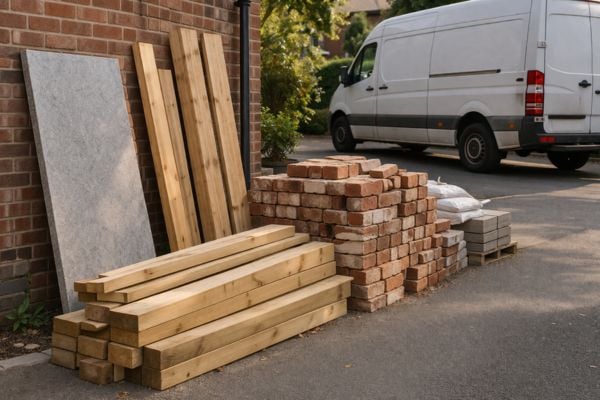

Buy from Travis Perkins or Jewson and delivery is built into the process. But reclaimed bricks from Gumtree, timber from a yard across the county, paving slabs from a landscaping company that only offers collection?
You're on your own. Building materials are heavy, awkward, and almost never a standard parcel shape. Most courier companies won't touch them.
This guide covers the practical options for getting building materials couriered across the UK.
Need building materials collected and delivered?
Get an instant quote for door-to-door courier service across the UK.
Get a Quote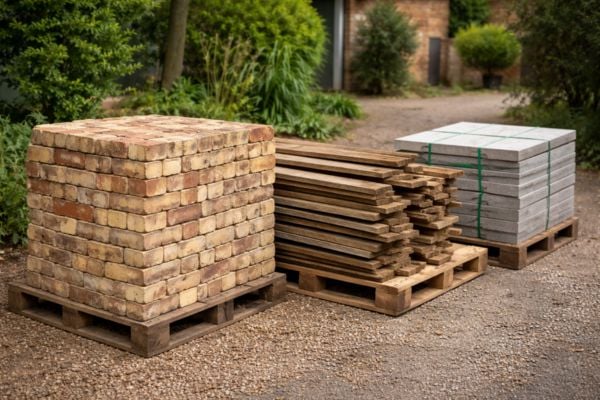
Too heavy for a parcel, too awkward for your car, but perfect for a van courier
What Counts as "Building Materials" for Courier Purposes?
Broadly, anything you'd use on a construction, renovation, or landscaping project that's too large or heavy for a standard parcel service. The most common items people need couriered include:
Timber and joinery. Lengths of timber, sheet materials (plywood, MDF, OSB), doors, door frames, window frames, worktops, skirting boards. Timber is long and heavy, and standard couriers have length limits that rule out most useful sizes.
Bricks, blocks, and stone. Reclaimed bricks, decorative stone, paving slabs, coping stones, lintels. These are extremely heavy relative to their size. A pallet of bricks can weigh over a tonne.
Plasterboard and insulation. Full sheets of plasterboard are 2.4m long and fragile. Insulation boards are bulky but light. Both are awkward shapes for standard couriers.
Roofing materials. Roof tiles (heavy), ridge tiles, flashing, EPDM rubber roofing. Often bought in bulk quantities that add up to serious weight quickly.
Bathroom and kitchen fittings. Baths, shower trays, ceramic basins, worktops, kitchen units. Fragile, heavy, and oddly shaped.
Reclaimed and salvage materials. This is a big one. Reclaimed oak beams, Victorian floor tiles, original cast iron radiators, architectural salvage. These are often one-off finds from demolition yards, salvage specialists, or private sellers on Marketplace and eBay, and they almost never come with delivery.
Why Standard Couriers Don't Work for Building Materials
Three reasons, usually all at once:
Weight. A standard courier parcel tops out at 30 to 70kg depending on the company. A dozen paving slabs weigh more than that. A single bag of cement is 25kg. Building materials blow through parcel weight limits almost immediately.
Size. Most couriers have a maximum length of 1.5 to 2.5 metres. A standard sheet of plywood is 2.44m x 1.22m. A length of 4x2 timber is 2.4m or longer. Anything involving full-length materials is out.
Fragility (ironically). Plasterboard cracks if you look at it wrong. Ceramic tiles chip in transit. Glass panels need careful handling. Building materials that go through a parcel sorting depot get stacked, shifted, and occasionally dropped alongside thousands of other packages. That's fine for a shoe box. It's not fine for a box of porcelain floor tiles.
Good to know: Pallet couriers are an option for very heavy, palletised loads (bricks, blocks, bags of cement). But most private buyers and small contractors aren't buying full pallets. They need a few dozen bricks, a handful of slabs, or a stack of timber. Van-based courier services fill the gap between "too heavy for a parcel" and "not enough for a pallet."
What Are Your Courier Options?
Large item courier. The most practical option for most building material deliveries. A large item courier service collects from the supplier, yard, or seller's address and delivers to your site or home. The materials travel in a van, not through a depot, so there's no risk of items being separated, stacked badly, or damaged in a sorting facility.
Man and van. For heavier loads or situations where loading help is needed, a man and van service provides a driver who can assist with the physical lifting. Particularly useful for heavy items like baths, worktops, reclaimed beams, and stacks of bricks where one person can't safely manage the loading.
Pallet courier. If you're buying materials in bulk (full pallets of bricks, bags of cement, blocks) a pallet courier with a tail-lift vehicle is the right tool. This is the commercial end of building material delivery and is priced accordingly.
DIY van hire. Renting a van from Enterprise or Europcar and doing it yourself is always an option. But once you factor in the hire cost, fuel, your time, and the physical effort of loading and unloading heavy materials, a courier often works out cheaper and saves you a full day.
Got materials that need moving?
Timber, bricks, slabs, worktops. Instant quote for any load.
Get a Quote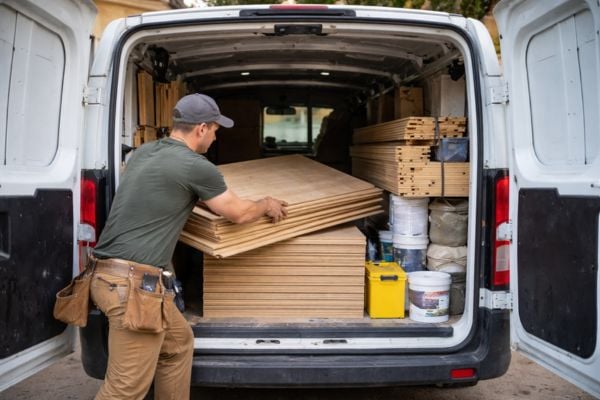
Van-based delivery keeps materials together and out of sorting depots
Buying Reclaimed or Second-Hand Building Materials
This is where courier services really earn their keep. The market for reclaimed building materials in the UK is booming. Reclaimed bricks, Victorian tiles, original floorboards, cast iron radiators, salvaged oak, architectural ironmongery. The quality is often better than new, the prices are lower, and there's the environmental benefit of reusing rather than manufacturing.
The problem is that these materials are almost always collection only. A salvage yard in Suffolk isn't going to post you a pallet of reclaimed London stock bricks. A private seller on Facebook Marketplace who's ripping out their original Victorian floor tiles isn't offering delivery.
A marketplace collection and delivery service handles this. The driver collects from the seller or yard and delivers to your address or site. For eBay collection only listings, the same process applies.
This opens up suppliers and sellers across the whole country rather than limiting you to whatever's within driving distance. Found the exact reclaimed brick you need for your extension, but the yard is 200 miles away? That's solvable.
Tip: When buying reclaimed materials, always get the exact weight from the seller before booking a courier. Reclaimed bricks, stone, and timber are often heavier than people expect because they're denser than modern equivalents. Getting the weight right means the driver arrives with the right vehicle.
Tips for Preparing Building Materials for Courier
Stack and bundle where possible. Loose bricks, tiles, and slabs should be stacked neatly and strapped together or placed in sturdy bags/crates. The easier it is to load, the faster the collection goes and the less risk of damage in transit.
Protect fragile surfaces. Worktops, doors, and sheet materials should have cardboard or blankets between them if stacked. Ceramic tiles need proper packaging, not just thrown loose into a box.
Be honest about the weight. Building materials are heavy. A "small" stack of paving slabs can easily weigh 200kg. Underestimating the weight leads to problems on collection day: the wrong vehicle, not enough people, or a driver who physically can't load the items safely.
Check site access. If the materials are being delivered to a building site, make sure the driver knows about any access restrictions: locked gates, narrow lanes, unpaved tracks, weight limits on roads. There's nothing worse than a van full of materials arriving at a site it can't physically reach.
Watch out: Some building materials are classed as hazardous for transport purposes. Certain adhesives, solvents, paints, and chemicals fall under ADR regulations. If you're sending anything chemical-based, check with the courier first. Standard courier services may not be able to carry them.
How Much Does It Cost to Courier Building Materials?
The cost depends on the total weight and volume of the load, the distance, and how quickly you need it. A few lengths of timber going 30 miles is a very different job from 500kg of reclaimed bricks crossing the country.
The quickest way to get an accurate price is to enter the collection and delivery postcodes into an instant quote tool, describe the materials and approximate weight, and you'll see the cost straight away.
Frequently Asked Questions
Can I courier building materials with a standard parcel service?
Only very small, light items. Most building materials exceed the weight and size limits of standard couriers. A van-based large item courier or man and van service is usually the right option.
How much does building material delivery cost?
It depends on the weight, volume, distance, and delivery speed. Use an instant quote tool for an accurate price based on your specific load and route.
Can I get reclaimed building materials collected from a private seller?
Yes. A marketplace collection and delivery service sends a driver to the seller's address to collect the materials and deliver them to your home or site. This works for Facebook Marketplace, eBay, Gumtree, and salvage yards.
What's the maximum weight a courier can handle?
Van-based couriers typically handle loads up to around 500–800kg depending on the vehicle. For heavier loads (full pallets of bricks, bulk aggregates), a pallet courier with a tail-lift vehicle is needed.
Can building materials be delivered to a construction site?
Yes. Porta's construction site courier service covers delivery to active sites across the UK. Make sure the driver has clear access instructions: gate codes, site contact numbers, any weight or width restrictions on access roads. Materials can usually be delivered to a specific drop point on site if arranged in advance.
Are there any building materials that couriers can't carry?
Some chemical products (adhesives, solvents, certain paints) fall under hazardous goods regulations and may need specialist transport. Standard courier services may not be able to carry these. Check with the courier before booking if your load includes anything chemical-based.