

A customer walks into your boutique wanting a dress in size 12. You've got size 10 and 14 on the rail, but the 12 is at your warehouse across town.
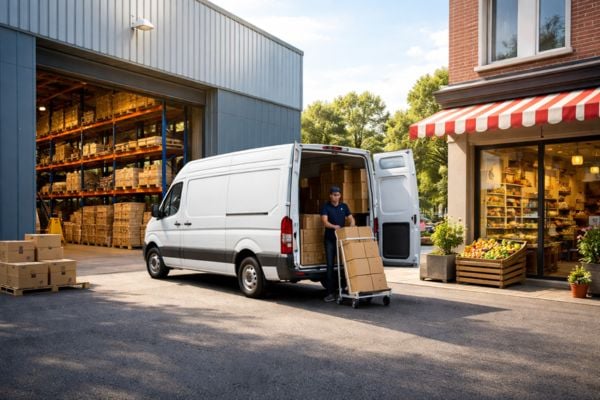
Warehouse to shop delivery services solve these daily retail headaches - getting stock from central storage to your shop floor quickly, and delivering customer purchases from warehouse to their homes when items aren't held in-store. For independent retailers without the logistics infrastructure of big chains, courier services bridge the gap between warehouse inventory and customer satisfaction.
What This Guide Covers
Warehouse to shop delivery services for independent UK retailers, realistic costs for stock replenishment and customer order delivery, how same-day services keep sales moving, what items can be couriered, and how small retailers compete with larger chains through smart logistics.
Why Independent Retailers Need Warehouse Delivery Services
Large retail chains have dedicated logistics teams and regular delivery schedules. Independent retailers need flexible solutions that match smaller scale and tighter budgets.
The Stock-Holding Problem
Small shops can't afford to stock every size, colour, and variant of products. A boutique with 800 sq ft retail space might have 5,000 SKU variants across clothing lines - impossible to display everything.
Central warehouse storage lets you hold full inventory ranges without cramming the shop floor. When customers want items not physically in-store, courier delivery from warehouse to shop (or direct to customer) completes sales that would otherwise be lost.
Customer Order Fulfilment
Modern retail increasingly involves "order in store, deliver to home" - customers browse physically, buy items not in stock, and expect home delivery. This requires warehouse to customer delivery capability.
Door-to-door courier services enable independent retailers to offer delivery experiences matching Amazon and large retailers, without building logistics infrastructure themselves.
Urgent Stock Replenishment
You're selling specific items faster than expected. Stock runs out Thursday, next scheduled delivery is Monday.
Weekend trading suffers unless you get urgent replenishment. Same-day courier services deliver stock within hours, preventing lost weekend sales worth hundreds of pounds.
For retailers with weekend trading peaks, Saturday delivery capability keeps popular items available during busiest trading periods.
Seasonal and Event-Based Demand
Christmas, Valentine's, Mother's Day - retail peaks create unpredictable demand. You can't stock six months' worth of Valentine's gifts year-round, but you need rapid replenishment during the two-week selling window.
Courier services provide flexibility to respond to demand spikes without permanent inventory investment. Order stock as you need it, delivered same-day or next-day from warehouse.
The Click-and-Collect Challenge
Customers increasingly expect click-and-collect - order online, collect in-store same day or next day. For small retailers, this requires warehouse to shop delivery within tight timeframes.
Without courier capability, you either hold massive inventory in-store (expensive) or disappoint customers with slow collection times (lost sales). Courier services make click-and-collect viable for independents.
What Warehouse to Shop Delivery Costs
Pricing varies based on urgency, distance, item size, and frequency. Here's realistic cost breakdown for independent retailers.
Local Same-Day Delivery (Under 20 Miles)
Most independent retailers operate within 20 miles of their warehouse or main stockroom. Local same-day delivery for urgent stock replenishment or customer orders represents the most common use case.
Small items (clothing, accessories, small boxed goods): £25-45 for standard same-day, £35-60 for urgent within 2-3 hours. Medium items (footwear boxes, multiple garments, small furniture): £35-65 standard same-day, £50-80 urgent.
Bulky items requiring larger vans add £10-25. Multiple items in one delivery (restocking several product lines) often work out cheaper per item than individual deliveries.
Regional Delivery (20-50 Miles)
Retailers sourcing from regional warehouses or delivering to customers beyond immediate local area face moderate distance delivery costs. Still economically viable for valuable sales or urgent replenishment.
Small parcels: £40-70 same-day. Medium items: £60-95.
Large or heavy items: £80-120. These costs make sense for completing £200+ sales or restocking fast-moving inventory that generates significant revenue.
Next-Day Scheduled Delivery
When urgency is lower - regular stock replenishment, planned customer orders with 1-2 day delivery promises - next-day scheduled delivery costs substantially less than same-day.
Local (under 20 miles): £15-30 depending on size. Regional (20-50 miles): £25-50.
Retailers with predictable patterns (weekly stock runs, regular customer orders) save significantly using scheduled delivery versus constant same-day urgency.
Contract Rates for Regular Users
Retailers using courier services regularly (multiple times weekly) negotiate contract rates below ad-hoc pricing. Volume discounts apply, priority service during peak periods, and account management support.
Daily or multi-weekly routes: £12-25 per delivery for small items, £20-40 for larger. These rates make warehouse-to-shop models economically viable even for moderate-value stock movements.
| Service Type | Distance | Delivery Time | Cost Range |
|---|---|---|---|
| Urgent same-day (small items) | Under 20 miles | 2-3 hours | £35-£60 |
| Standard same-day (small items) | Under 20 miles | 4-6 hours | £25-£45 |
| Same-day regional (medium items) | 20-50 miles | 4-6 hours | £60-£95 |
| Next-day scheduled (small items) | Under 20 miles | Next day | £15-£30 |
| Next-day regional | 20-50 miles | Next day | £25-£50 |
| Large/bulky items same-day | Under 20 miles | 4-6 hours | £45-£80 |
| Contract regular delivery | Under 20 miles | Scheduled | £12-£40 |
| Weekend/Saturday delivery | Under 20 miles | Same day | £35-£70 |
Price Disclaimer: These costs are reflective of current UK market rates at the time of writing and are provided as general guidance only. Actual prices vary significantly based on exact distance, item size/weight, urgency level, day of week (weekend premium applies), and specific courier provider. Retailers with regular delivery requirements typically negotiate better rates than occasional users. Always obtain quotes for your specific delivery needs.
Get An Instant Quote →Types of Retail Deliveries
Warehouse to shop courier services handle diverse retail scenarios. Understanding common delivery types helps planning and budgeting.
Clothing and Fashion
Boutiques and independent fashion retailers most commonly use warehouse delivery. Customer wants specific size or colour not in store - courier brings it from central stock within hours.
Garment bags, shoe boxes, accessory items - lightweight, easily transported, high enough value (£50-300+ per item) to justify £30-60 courier costs. The sale depends on getting the right item quickly.
Seasonal stock replenishment also matters enormously. Your coat display sells out during cold snap - courier delivers replacement stock from warehouse same afternoon, catching weekend trading.
Furniture and Homeware
Independent furniture shops rarely hold entire ranges in showrooms. Customers order specific items, which get delivered from warehouse to their homes.
For bulky items like furniture, specialist couriers with appropriate vehicles and two-person teams handle deliveries. Costs reflect vehicle size and labour - £80-200 locally, but margins on furniture sales (£500-2,000+) absorb delivery expenses.
Some furniture retailers operate "showroom model" - minimal stock on display, everything delivered from warehouse. This reduces retail space costs dramatically while still offering full ranges.
Gifts and Specialist Items
Gift shops, toy stores, specialist retailers - items customers often want immediately but might not be in stock. Teddy bear in specific size, particular board game, gift hamper components.
Same-day courier from warehouse to shop lets you complete impulse purchases. Customer doesn't want to wait 3-4 days for standard delivery - they want it today, or they'll buy elsewhere.
Food and Drink Specialists
Delis, wine merchants, speciality food shops - products with specific storage requirements. Central temperature-controlled warehouse holds bulk stock; shop carries working inventory with courier replenishment as needed.
Courier delivery maintains product quality (wine temperature control, cheese freshness) better than customers collecting from warehouses themselves. Professional handling preserves value.
Multi-Store Retailers
Independent retailers with 2-3 locations benefit enormously from warehouse-to-shop logistics. Central warehouse supplies all shops via courier rather than each location holding full inventory.
Stock imbalances get resolved quickly - shop A has excess of item that shop B needs. Courier transfer between locations maintains optimal stock distribution across your retail network.
High-Value and Jewellery
Jewellery, watches, collectibles - items too valuable to hold extensive inventory in every retail location. Secure courier delivery from vault or central storage to shop when customers want to view or purchase specific pieces.
Insurance matters critically here. Standard courier cover (£500-1,000) inadequately protects £5,000 watches.
Specialist couriers offer enhanced insurance (up to £25,000+ cover) for high-value retail items. Premium costs (1-2% of value) protect against catastrophic loss.
How Warehouse to Shop Delivery Works
The logistics process differs from consumer parcel delivery. Understanding workflow helps retailers use services effectively.
Stock Request and Booking
Customer wants item not in shop. You check warehouse stock (inventory system or phone call), confirm availability, and book courier collection.
Most courier services offer immediate phone booking with collection within 1-2 hours for urgent requests. Online booking platforms work for less urgent scheduled deliveries.
Provide accurate details: collection address (warehouse), delivery address (shop or customer home), item description, value (for insurance), and urgency level.
Collection from Warehouse
Courier collects from your warehouse or storage facility. This requires someone at warehouse to hand over items - either warehouse staff, or if you're operating self-storage, you might need to be there yourself.
Good inventory management means items are ready when courier arrives. Delays (can't find item, wasn't packed, warehouse person unavailable) cost time and sometimes trigger waiting time charges.
Delivery Options
Three common delivery scenarios: direct to shop (stock replenishment), direct to customer home (customer orders), or shop-as-collection-point (customer collects from shop after courier delivers there).
Direct customer delivery requires collection of customer address details and contact information. Shops typically add delivery charge to customer's purchase or absorb it as cost of sale.
Shop delivery might be to staff entrance, storage room, or retail floor depending on item type and shop layout. Clear delivery instructions prevent couriers leaving items in wrong locations.
Tracking and Communication
Real-time tracking helps manage customer expectations. When customer's dress is en route from warehouse, you can give accurate delivery estimates rather than vague "sometime this afternoon."
Proof of delivery documentation (signature, timestamp, photo) protects against disputes. Customer claims item wasn't delivered, but courier proof shows otherwise.
Customer Communication Strategy
When items need warehouse delivery, set clear expectations with customers. "I'll have this delivered to the shop by 3pm today, can you collect after 3:30?" prevents customers showing up too early and getting frustrated.
For direct home delivery, provide tracking information to customers. Reduces "where's my order" calls and improves customer experience through transparency.
Making Warehouse-to-Shop Models Work Financially
Courier costs need to make economic sense relative to sales and margins. Smart retailers optimize logistics to maximize profitability.
The Inventory Calculation
Holding £30,000 stock in-shop versus £10,000 in-shop plus £20,000 in warehouse saves shop rent (smaller space) and reduces theft/damage risk. Courier costs to access warehouse stock might run £500-2,000 monthly but save £500+ monthly in reduced rent.
The break-even calculation: if courier expenses are less than the savings from reduced retail space and inventory management, the warehouse model works financially.
Passing Delivery Costs to Customers
Many retailers add delivery charges for items not in stock. "This item is £120, plus £8 delivery charge if you'd like it delivered to your home tomorrow."
Customers increasingly expect delivery charges - Amazon Prime has actually made people more accepting of paying for fast delivery. £5-15 delivery charge on £100+ purchases rarely stops sales.
Alternatively, build delivery costs into product margins. A dress with £60 cost, £120 sale price has £60 margin - easily absorbs £30-40 courier cost when needed while still maintaining profitability.
Batching Deliveries
Accumulate multiple items for single courier run rather than individual deliveries per item. Three customers want items from warehouse - deliver all three to shop in one courier trip (£35-50) rather than three separate deliveries (£90-120).
This requires managing customer expectations - "I can have this here tomorrow afternoon when our warehouse delivery arrives" rather than "delivered within 2 hours."
Contract Rates and Volume Discounts
Retailers using couriers regularly negotiate monthly contracts with volume discounts. 20-30 deliveries monthly at £20-25 each (£400-750) versus same deliveries at ad-hoc rates of £35-45 each (£700-1,350).
The savings compound significantly over time. Annual courier costs might be £8,000 on contract versus £14,000 ad-hoc - that's £6,000 saved purely through volume negotiation.
Click-and-Collect as Competitive Advantage
Offering "order online, collect in-store same day" differentiates independent retailers from pure online competitors and matches big retail chains.
Customers value the ability to browse online (full range visible), order specific items, and collect quickly from local shop. This requires warehouse-to-shop delivery capability, but generates sales that wouldn't otherwise exist.
The courier cost (£25-40 typically) is simply cost of acquisition for sales worth £100-500+.
Choosing Reliable Courier Services for Retail
Not all couriers understand retail requirements. Choosing appropriate services prevents disappointment and maintains customer satisfaction.
Understanding Retail Urgency
When a customer is waiting in shop for an item being couriered from warehouse, "same day" means "this afternoon" not "before midnight." Couriers need to understand retail timeframes.
Ask potential couriers: What's your typical collection time after booking? What's realistic same-day delivery timeframe? Can you handle urgent deliveries when customers are literally waiting?
Couriers with retail experience understand these pressures better than those primarily handling general parcels.
Weekend and Extended Hours Coverage
Retail happens weekends and evenings. Your Saturday customers want items just as urgently as Wednesday ones.
Confirm courier availability matches your trading hours. A courier that only operates Monday-Friday 9-5 doesn't help Saturday afternoon emergencies.
Handling Capabilities
Retail items vary enormously - delicate clothing requiring garment bags, fragile homeware needing careful packaging, awkward furniture needing two-person teams. Not all couriers handle all item types.
Match courier capabilities to your product types. Clothing boutique needs different courier than furniture shop or wine merchant.
Insurance and Liability
Retail stock often exceeds standard courier insurance (£500-1,000 per item). A dress worth £300, furniture piece worth £800, jewellery worth £3,000 - all need appropriate coverage.
Confirm insurance limits and enhancement options. Enhanced insurance costs typically 1-2% of item value - £300 dress needs £3-6 insurance premium, acceptable cost for protecting valuable stock.
Understand claims processes before problems occur. When items do get damaged or lost, quick resolution prevents customer disappointment cascading into reputation damage.
Courier Reliability and Reputation
Your courier service reflects on your retail brand. Late deliveries, damaged items, poor communication - customers blame you, not the courier.
Check courier references from other retailers. One missed delivery costs you a customer complaint; systematic unreliability destroys your business reputation.
Pay slightly more for reliable couriers rather than cheapest available. The difference between £35 and £45 delivery is trivial; the difference between reliable and unreliable service is business-critical.
Common Warehouse to Shop Delivery Problems
Certain issues appear repeatedly with retail courier usage. Understanding them helps avoid the same mistakes.
Stock Availability Confusion
You promise customer item will arrive from warehouse within hours. Courier arrives at warehouse - item isn't actually there, or wrong variant, or damaged.
Prevention: Confirm warehouse stock immediately before booking courier, not relying on inventory systems that might be out of date. Quick phone call to warehouse prevents wasted courier costs and customer disappointment.
Delivery Timing Miscommunication
You tell customer "item will be here by 2pm." Courier delivers at 4:30pm.
Customer has left frustrated, sale is lost, reputation damaged. Underpromise and overdeliver - if courier says "4-6 hours," tell customer "this afternoon after 3pm" not "by 2pm."
Packaging Inadequacy
Warehouse staff package items poorly for courier transport. Delicate clothing arrives creased, glassware broken, products damaged.
Implement packaging standards at warehouse. Items being couriered need proper protection - boxes, padding, garment bags - not just chucked in plastic bags.
Train warehouse staff that courier items require better packaging than items being carried personally. Five minutes extra packaging prevents customer disappointment and replacement costs.
Customer Address Errors
For direct customer deliveries, incorrect addresses cause failed deliveries and wasted courier costs. Customer writes address in shop, handwriting is unclear, postcode is wrong.
Verify addresses when taking customer details. Read back full address including postcode. Check postcode is valid (most courier booking systems flag invalid postcodes).
Multiple Shop Coordination
Retailers with multiple locations sometimes send couriers to wrong shop. Customer ordered at shop A, item gets delivered to shop B.
Clear delivery instructions including shop name and location prevent mix-ups. "High Street shop, next to Boots" is clearer than just street address when you operate multiple nearby locations.
Managing Peak Period Chaos
Christmas, sales periods, local events - retail peaks create courier booking surges. Plan ahead during peak periods, book courier slots in advance where possible, and maintain backup courier contacts for when your primary service is overwhelmed.
Peak periods also command premium pricing (20-40% surcharges common). Factor this into customer delivery charges or accept reduced margins during peak trading.
Final Thoughts: Warehouse to Shop Delivery as Retail Enabler
Warehouse to shop delivery services level the playing field between independent retailers and large chains. Big retailers have dedicated logistics infrastructure and regular delivery schedules.
Small independents can now match these capabilities through flexible courier services. The ability to offer full product ranges without holding everything in-store, provide click-and-collect services, and deliver purchases to customer homes creates competitive advantages previously impossible for small retailers.
The costs - £25-80 for local same-day delivery, £15-50 for planned deliveries - integrate readily into retail economics. When courier expense completes a £200 sale that otherwise wouldn't happen, or prevents £500 worth of lost weekend trading through urgent stock replenishment, the return on investment is obvious.
Smart retailers view courier services not as operational expenses but as revenue enablers. Each delivery represents either a completed sale, satisfied customer, or prevented stockout.
The courier cost is simply the price of retail flexibility. Building relationships with reliable courier services - understanding their capabilities, negotiating appropriate rates, integrating them into retail operations - transforms independent retailers' ability to compete effectively.
Our Recommendation
For independent retailers looking to implement warehouse-to-shop logistics, starting with reliable local courier partnerships provides immediate competitive benefits. Services like Porta Delivery understand retail urgency and can provide flexible solutions matching independent retailer needs and budgets.
The UK has excellent courier availability at all service levels - from emergency same-day to contract scheduled deliveries. The challenge isn't finding couriers but rather integrating courier capability strategically into your retail operations, training staff in effective courier usage, and managing costs to maintain profitability while delivering excellent customer service.