

Door-to-door parcel collection sounds straightforward enough, but knowing how the process actually works can save you from annoying surprises. Most courier companies have got the basics down, though the experience varies wildly depending on who you book with and what you're sending.
Here's what actually happens when you book door-to-door parcel collection in the UK, including the bits the courier websites conveniently forget to mention.
Step 1: Getting a Quote and Booking Collection
Everything starts with a quote. You'll need to provide the collection address, delivery address, parcel dimensions, and weight. This is where people immediately start lying to themselves about measurements, which never ends well. That box is not 40cm when it's actually 52cm, and pretending otherwise just means the driver won't take it.
Most courier companies have online booking systems that'll give you a price instantly. You pick your collection date (usually next working day at the earliest, though some offer same-day if you book before a certain cut-off time). You'll typically get to choose morning or afternoon collection, and the better services narrow this down to specific hour-long windows.
Pay upfront via card, get a booking confirmation email, and you're set. Some services send you a label to print and stick on your parcel. Others generate a QR code that the driver will scan. A few still email you a PDF with detailed instructions that nobody reads until the driver's already knocked on the door.
💡 Booking Tip
Book your collection for a day when you'll definitely be home. Rearranging collections is possible but usually involves phoning customer service, and nobody wants that.
Step 2: Preparing Your Parcel
Between booking and collection, you need to actually get your parcel ready. This means proper packaging, not just shoving something in an old Tesco bag and hoping for the best.
For small items, a sturdy cardboard box with bubble wrap or packaging paper works fine. Seal it properly with parcel tape (not Sellotape, not masking tape, actual parcel tape that won't peel off halfway to Birmingham). If you're sending something fragile, wrap it like you're sending it to the moon. Couriers aren't deliberately rough with parcels, but a box might get stacked under three others or slide about in a van. Plan accordingly.
Larger items are where it gets interesting. A sofa doesn't fit in a box, obviously. Most large item courier services will wrap furniture in blankets or shrink wrap as part of the collection, but it helps if you've at least removed the cushions and checked nothing's going to fall off during transit.
Stick your label on securely if you've been sent one. If you're using a QR code system, have your phone ready with the email open. Write the recipient's address legibly on the parcel as well, even if you've already put it on the label. Belt and braces approach – if the label falls off, at least there's still writing on the box.
Step 3: The Actual Collection
On collection day, you'll usually get a text or email in the morning confirming the driver is on their way. Better services give you a one-hour window and update you as they get closer. Budget services give you "morning" or "afternoon" and leave you guessing.
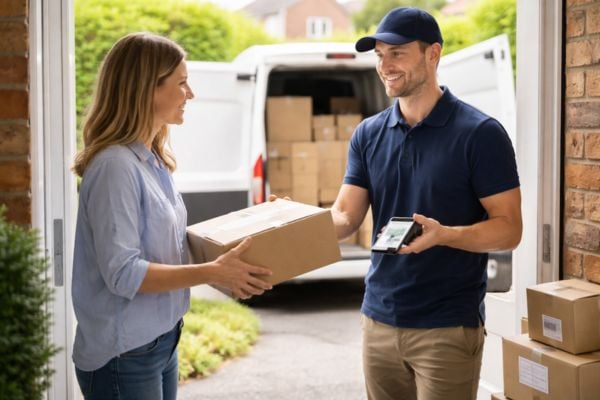
The driver arrives, checks the parcel matches what was booked, scans the label or QR code, and loads it into their van. Takes about two minutes for a standard parcel. For larger items, they'll often have a second person to help with lifting, though you should check this when booking rather than assuming.
You'll get a collection confirmation once the driver's scanned your parcel. This is important – it's your proof that the courier company has taken possession of your item. Screenshot it or save the email, because if something goes missing later, this is where your claim starts.
Some drivers will give you a physical receipt as well. Others just rely on the electronic confirmation. Either way, make sure you've got something showing the parcel was collected and what condition it was in when it left your possession.
Step 4: Transit and Tracking
Once your parcel's been collected, what happens next depends on the type of service you've booked. True door-to-door courier services keep handling to a minimum. Your item stays with one driver or gets handed off once to another driver heading in the right direction.
Standard parcel services, even when they offer "door-to-door collection", often route everything through sorting hubs. Your parcel gets collected from your house in Manchester, driven to a depot in Warrington, sorted overnight, sent to another depot near the destination, then loaded onto a delivery van. More steps mean more time and more opportunities for things to go sideways, but it's cheaper for the courier company to run this way.
Tracking varies enormously. The good services update you at each stage: collected, in transit, out for delivery, delivered. You can watch your parcel's journey in real-time or at least get notifications when something changes. The less good services give you "parcel collected" and then nothing until "parcel delivered" two days later, which is nerve-wracking if you're sending something valuable.
Most UK couriers now offer some form of tracking as standard. Even the budget options give you a tracking number you can check online. The difference is in how detailed and how timely those updates are.
⚠️ Tracking Reality Check
"Out for delivery" doesn't always mean your parcel will arrive that day. It means it's on a van somewhere. It might be stop number 3 or stop number 47. Manage your expectations accordingly.
Step 5: Final Delivery
The parcel arrives at the recipient's address. Ideally, someone's home to receive it and sign for it (if required). The driver scans it as delivered, you get a notification, job done. This is what happens maybe 70% of the time.
The other 30% involves failed delivery attempts. Nobody was home, the address was incomplete, there was nowhere safe to leave the parcel, the dog looked scary. Whatever the reason, the parcel didn't get delivered on the first try. What happens next depends on the courier and the instructions given at booking.
Some services will attempt redelivery the next working day. Others leave a card and take the parcel to a local depot for collection. A few will text the recipient asking where they'd like the parcel left (with a neighbour, in the shed, behind the wheelie bin). The best services let you rearrange delivery for a specific date or redirect to a different address entirely.
For larger items that need two people to carry, failed deliveries are more complicated. You can't exactly leave a three-seater sofa with next door or behind the bins. These typically require rescheduling with the recipient to arrange a time when someone's definitely home.
Different Types of Door-to-Door Service
Not all door-to-door services work the same way. Understanding the differences helps you pick the right one for what you're sending.
Standard next-day delivery is your basic option. Collection happens within 24 hours of booking, delivery within 24 hours of collection. Your parcel goes through the courier network at normal priority. This works fine for most things and it's the cheapest door-to-door option.
Same-day delivery costs more but does what it says. Collection and delivery happen on the same day. Essential for urgent documents or time-sensitive items. Most same-day courier services require booking before midday for same-day delivery, though some offer later cut-offs for local deliveries.
Timed delivery guarantees arrival by a specific time (usually before 9am, 10am, or noon). You pay a premium for this, but it's worth it when timing actually matters. Medical samples, legal documents, anything with a genuine deadline rather than just general impatience.
Economy services are slower but cheaper. Collection within 48 hours, delivery within 3-5 working days. Fine for non-urgent items when you're trying to keep costs down. Your parcel will get there eventually, it just won't be quick about it.
What Can Go Wrong (And What to Do About It)
Door-to-door collection is generally reliable, but things do occasionally go wrong. Here's what to watch for and how to handle it.
Driver doesn't turn up. Wait until the end of your collection window before panicking. If they still haven't arrived, check your tracking or contact the courier. Sometimes drivers run late. Sometimes there's been a mistake with the booking. Either way, you'll need to reschedule collection for another day.
Parcel is damaged in transit. This is what insurance is for. Document the damage with photos immediately, contact the courier within their claims window (usually 3-7 days), and follow their claims process. Save all your booking confirmations and correspondence.
Parcel goes missing. Give it a couple of days past the expected delivery date before declaring it lost. Couriers sometimes mark things as delivered early by mistake. If it's genuinely missing, file a claim. The courier will investigate, which mostly involves checking whether it was scanned at various points in their system.
Wrong item collected. If the driver collects something that wasn't meant to go, contact the courier immediately. You might be able to intercept it before it's delivered. Failing that, you'll need to arrange return delivery and hopefully get a refund.
Delivery address was wrong. This one's usually user error rather than courier error. If you've typed the postcode wrong or forgotten to include a flat number, the parcel might bounce around their system for a bit before being returned to sender. Check addresses carefully before booking.
💡 Problem Prevention
Take photos of your parcel before it's collected, including any existing damage, the packaging condition, and the label. If something goes wrong later, you'll have timestamped evidence of what you sent.
Cost and Insurance
Door-to-door collection pricing depends on size, weight, distance, and speed. A small parcel next-day might cost £6-12. A large item same-day could run £50-150 depending on distance. Most services include basic insurance (typically £20-50) in the base price.
If you're sending something valuable, pay for additional insurance. It costs a couple of quid extra and it's worth it for peace of mind. Standard cover won't replace your £800 laptop if it gets lost. You'd get £50 and a shrug. Declared value insurance costs more but actually covers what you're sending.
Read the terms and conditions on what's covered and what isn't. Most couriers won't insure cash, jewellery, or items over a certain value (often £1000-2000) regardless of what you declare. If you're sending something extremely valuable or irreplaceable, standard courier insurance probably isn't adequate anyway. You need specialist shipping.
Is Door-to-Door Collection Worth It?
For most people in most situations, yes. The convenience of having a courier collect from your doorstep rather than driving to a depot saves time and hassle. You're not queuing at the post office, you're not trying to cram a parcel into your car, and you're not hoping the depot's still open when you finish work.
It costs more than depot drop-off, but the difference is usually a few pounds rather than something prohibitive. If your time has any value at all, door-to-door collection pays for itself. And for anything heavy or bulky, it's not really optional. You're getting collection service whether you like it or not, because depots won't accept your wardrobe.
The key is choosing a reputable courier service that actually does what it says. Check reviews, read the terms and conditions, understand what's included in the price, and don't just go for the absolute cheapest option if it's got terrible ratings. A reliable door-to-door service is worth paying a bit extra for. A unreliable one isn't worth using at any price.